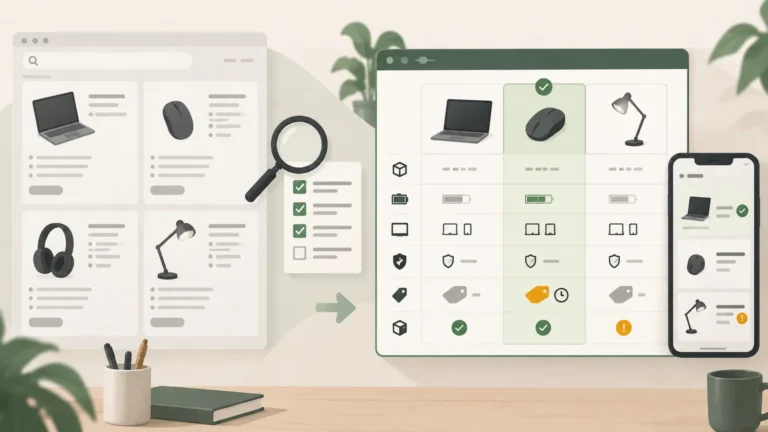

Buying Guides Should Reduce Decision Friction
TLDR: Ecommerce buying guide quality is not determined by length, product tables, or the number of items linked. A useful guide resolves a specific pre-purchase decision that category and product pages cannot resolve alone. It explains the criteria that change the choice, supports recommendations at an appropriate evidence level, acknowledges limitations, provides relevant product paths, and has an owner responsible for keeping it accurate.
The quickest test is simple: remove the product links and ask whether the guide still teaches the shopper how to choose. If nothing useful remains beyond generic claims such as “consider quality, price, and durability,” the page is probably commercial scaffolding rather than decision support.
That distinction matters because a buying guide should have a clear reader job. Google’s people-first content guidance emphasizes a clear purpose, original information or analysis where appropriate, and enough useful information for readers to achieve their goal. It does not prescribe a magic length or template.
First, identify the page’s actual job
Buying guides often become muddled because teams ask one URL to act as a category page, product directory, educational article, and independent review. Those formats can support one another, but they do different work and carry different evidence requirements.
| Page type | Primary reader task | Content that earns its place | Common failure mode |
|---|---|---|---|
| Category or collection page | Browse products that meet known requirements | Useful filters, clear product differences, inventory, pricing, and concise category context | A long generic essay pushes products down without helping selection |
| Product page | Evaluate one purchasable item | Accurate specifications, compatibility, price, availability, shipping, returns, images, and limitations | Manufacturer language is repeated without resolving practical questions |
| Buying guide | Learn how to choose among product types or configurations | Decision criteria, terminology, trade-offs, use-case paths, and links to suitable collections or products | The page paraphrases category copy and adds arbitrary product links |
| Review or comparison | Evaluate named products against an explicit basis | Method, evidence, material differences, advantages, drawbacks, and recommendation logic | Unsupported “best” labels imitate independent testing that never occurred |
A merchant buying guide does not have to pretend to be an independent review. It can be valuable by explaining compatibility, materials, sizing, care requirements, total cost, or which configuration fits a particular use. The problem begins when a merchant recommendation is dressed up as neutral comparative research without disclosing its basis.
Audit ecommerce buying guide quality in five parts
1. Decision clarity
Name the decision in one sentence. “This guide helps shoppers choose a printer” is too broad. “This guide helps a small office choose between inkjet and laser printing based on monthly volume, color needs, and running costs” gives the page boundaries.
Next, identify the few criteria that can actually change the recommendation. A guide does not become more useful by listing every available specification. It becomes useful by separating decisive criteria from secondary preferences.
- What is the buyer trying to accomplish?
- Which constraints could rule out an otherwise suitable product?
- Which two or three trade-offs explain most of the choice?
- When would the default recommendation be wrong?
- What information must the buyer know before moving to a product list?
Segment advice by recognizable use cases rather than vague customer types. “Best for professionals” says little unless professional use creates measurable requirements such as higher volume, a particular file format, regulatory compliance, or faster turnaround.
2. Information gain
The guide should contribute something the product grid, filters, specifications, and manufacturer copy do not already provide. That contribution might be a decision tree, a compatibility explanation, a selection matrix, a worked scenario, or a plain-English account of why two similar specifications produce different practical outcomes.
This is where many guides fail. They turn 20 product-card attributes into 1,500 words without making the choice easier. Reformatting existing information is not necessarily useful interpretation.
During an audit, compare the guide with the category page side by side. Highlight every statement that adds a rule, trade-off, caveat, or useful explanation. If very little survives, merge the essential advice into the category experience or rebuild the guide around a narrower decision. For larger inventories, a template content quality audit can help teams apply the same test consistently rather than judging pages by word count.
3. Recommendation integrity
Words such as “best,” “top,” and “ideal” imply a basis for comparison. State that basis. A product might be the best fit for a defined budget, environment, compatibility requirement, or use case without being universally superior.
Google’s guidance for high-quality reviews recommends explaining what distinguishes products, discussing benefits and drawbacks, showing relevant expertise, and supporting recommendations with useful evidence when available. It also encourages publishers to explain why a product is best for a particular purpose.
Match the claim to the evidence you possess. If the team compared documented specifications, say so. If it interviewed support staff about recurring compatibility questions, describe that input. If it performed original testing, document what was assessed, the conditions, the sample, and important limitations. Do not imply hands-on testing merely because the page includes original photographs or a polished scorecard.
Recommendation integrity also requires drawbacks. A guide that presents every option as excellent is not guiding; it is distributing praise. Explain when an option is unsuitable, what a buyer gives up, and which constraint should trigger a different choice.
Review and testimonial practices also have legal implications. The FTC says its Consumer Reviews and Testimonials Rule took effect on October 21, 2024 and addresses specified deceptive practices, including fake or false reviews and falsely represented independence. Teams publishing review-like guides should review the FTC’s rule questions and answers and obtain appropriate legal guidance for their circumstances.
4. Commercial and architectural fit
A guide should help readers act at the moment their requirements become clear. Link a use case to the relevant category, filtered collection, or product rather than placing a generic wall of product cards at the end.
For example, after explaining that removable adhesive is appropriate for temporary indoor labeling, the guide can point to the matching collection. A different section discussing prolonged outdoor exposure should lead to options designed for that requirement. The destination follows the decision instead of interrupting it.
These paths matter for site structure as well as usability. Google’s ecommerce documentation says navigation and links help it understand relationships among pages and their relative importance. Use crawlable contextual links, clear anchor text, and destinations that genuinely satisfy the stated requirement.
Avoid duplicating a category page. The guide explains how to choose; the category page lets the shopper browse qualifying products. If both pages target the same broad query, carry almost identical copy, and lead to the same undifferentiated grid, the site may have created two weak answers instead of one strong experience.
5. Maintenance reality
Buying guides age through their recommendations, not just their publication dates. Products are discontinued, specifications change, prices move, links break, and shipping or return terms can alter the practical choice. A visually fresh date does not correct stale advice.
Assign an owner and define refresh triggers. Useful triggers include a named product becoming unavailable, a material specification changing, a collection being reorganized, a new compatibility standard appearing, or customer-service data revealing a recurring question the guide does not answer.
Check product facts against the systems that own them. Google notes that product data can communicate facts such as price, availability, shipping, and returns, although a particular search appearance is not guaranteed. The same discipline should apply on-site: avoid manually repeating volatile facts throughout editorial copy when a maintained product component can present them more reliably.
Worked example: repair a generic waterproof-label guide
Consider an illustrative guide titled “How to Choose the Best Waterproof Labels.” The weak version defines waterproof labels, repeats claims from a collection page, names several products as “top choices,” and ends with a product grid. It never explains what waterproof means in context or whether the recommendations are based on specifications, supplier statements, or testing.
A repaired version would begin by narrowing the decision. The shopper may need to distinguish occasional splashes from prolonged outdoor exposure, identify the application surface, decide whether removal matters, and account for temperature or cleaning conditions. Those factors create useful selection paths.
- Define the exposure scenario without making unsupported performance promises.
- Ask what surface the label will be applied to and whether that surface is smooth, curved, textured, or difficult to bond to.
- Separate permanent applications from cases where clean removal matters.
- Explain which documented material or adhesive attributes correspond to each path.
- State important limits and direct each path to an appropriate collection or product.
- Use test results only if the method and conditions can be documented; otherwise attribute performance information to its source.
The improved guide does not need to be longer. It needs to make the recommendation traceable. A reader should be able to say, “This is my exposure, surface, and removal requirement, so this is the product class I should inspect.” That is a completed decision step.
A practical buying-guide audit checklist
- Can the team state the shopper’s decision in one precise sentence?
- Does the guide solve a problem the category and product pages do not already solve?
- Are the decisive criteria separated from secondary specifications?
- Does the page add interpretation, trade-offs, scenarios, or selection rules rather than paraphrasing existing copy?
- Does every comparative, “best,” or recommended claim have an explicit and proportionate basis?
- Are methods, scope, and limitations disclosed when testing or first-hand experience is claimed?
- Does the guide identify meaningful drawbacks, incompatibilities, and unsuitable use cases?
- Can readers move from each decision point to a relevant category, filter, or product through a contextual link?
- Are named products available and accurately described under current specifications and commercial terms?
- Is there a named owner and a set of event-based refresh triggers?
- Should the page remain a guide, be merged into a category page, become a properly evidenced comparison, or be retired?
Do not confuse implementation signals with guide quality
Structured data, publication dates, product tables, and long copy can support a page, but none proves that the page helps shoppers. Google distinguishes product-related editorial pages, such as reviews, from merchant pages where a shopper can purchase a product. Use the markup appropriate to the page and its actual function; do not reshape the editorial purpose merely to pursue a search feature.
Likewise, avoid diagnosing weak guides with outdated algorithm shorthand. Google says the helpful content system became part of its core ranking systems during the March 2024 core update rather than remaining a separate standalone system. Its ranking-systems documentation also says Panda was announced in 2011 and incorporated into core systems in 2015. Calling a decline a “helpful content penalty” or “Panda hit” does not establish a cause or produce a repair plan.
The next step is a decision audit, not another rewrite
Start with guides receiving impressions but weak clicks, guides that attract visits without moving readers toward relevant collections, and guides containing discontinued or stale recommendations. Diagnose measurement and intent before assuming more copy will fix the problem; the same principle applies when refreshing a ranking page that no longer converts.
For each guide, record four things: the shopper decision, the unique information supplied, the evidence standard behind recommendations, and the next appropriate product path. Rebuild pages that have a defensible job. Merge useful fragments into stronger category experiences when a separate guide adds no value. Stop producing guides that exist only because a keyword appeared in a content calendar.
The standard is not whether a guide looks comprehensive. It is whether a shopper leaves with a smaller, better-defined choice and an honest reason for making it.
References
- Creating Helpful, Reliable, People-First Content | Google Search Central | Documentation | Google for Developers
- How To Write Reviews | Google Search Central | Documentation | Google for Developers
- The Consumer Reviews and Testimonials Rule: Questions and Answers | Federal Trade Commission
- Ecommerce Website Navigation Structure | Google Search Central | Documentation | Google for Developers
- Share Your Product Data With Google | Google Search Central | Documentation | Google for Developers
- Intro to Product Structured Data on Google | Google Search Central | Documentation | Google for Developers
- A Guide to Google Search Ranking Systems | Google Search Central | Documentation | Google for Developers