DTF Transfers Vs Screen Printing: Which Is Better?
TLDR
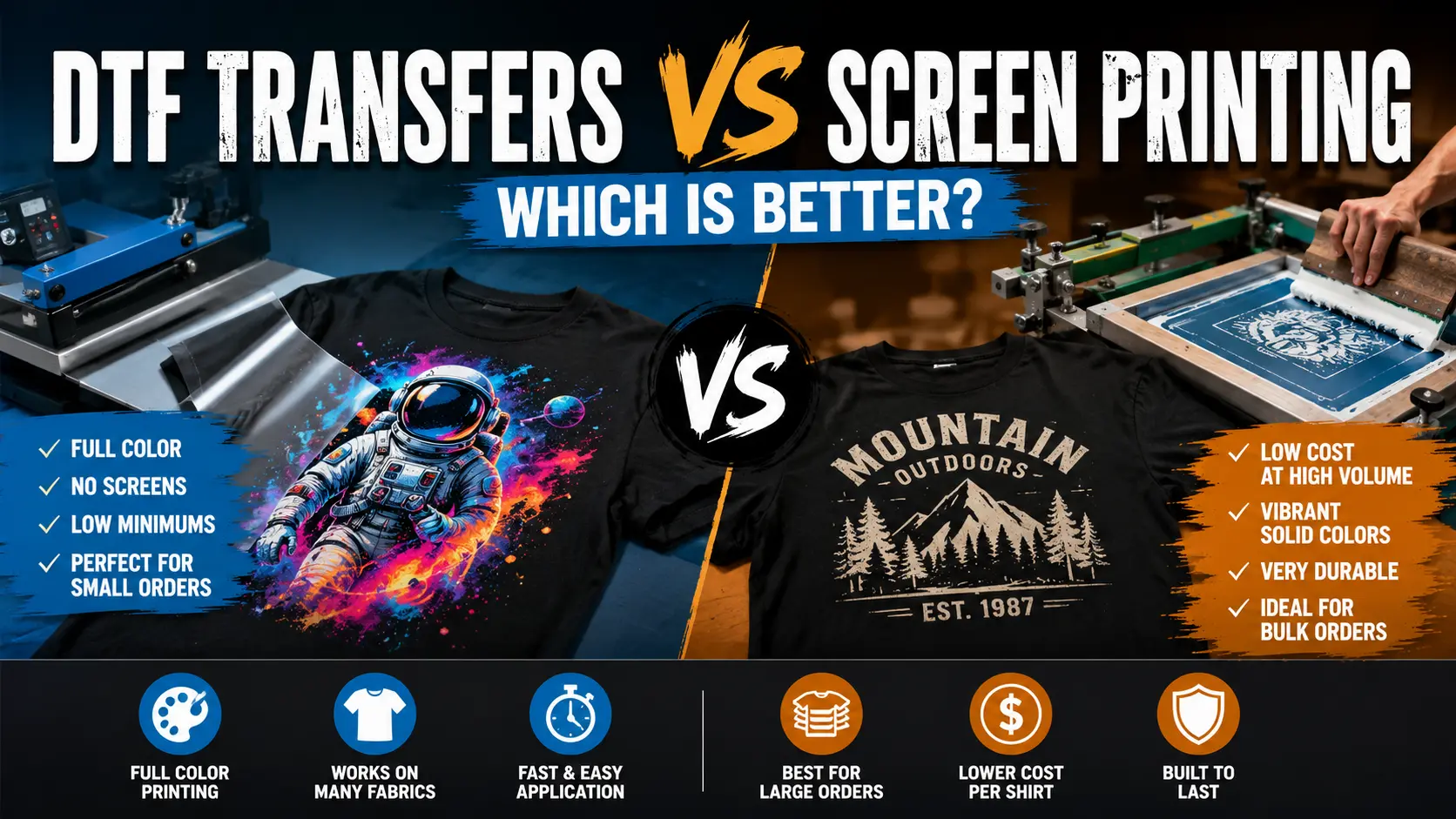
DTF transfers are usually better for small batches, full-color artwork, photo-style designs, merch drops, and custom apparel with lots of detail.
Screen printing is usually better for large bulk orders, simple designs, limited colors, and jobs where the lowest per-shirt cost matters most.
For most small brands, teams, events, and creators, DTF is easier to start with because it does not require screens, color separation, or large minimums. You can order custom DTF transfers from CustomStickers.com, press them onto shirts, hoodies, totes, and other apparel, and avoid a lot of the setup work that comes with screen printing.
The honest answer is that DTF transfers vs screen printing is not a contest with one permanent winner. It is a production choice. The better option depends on your artwork, quantity, fabric, budget, and how much setup you want to deal with.
A one-color logo on 500 shirts? Screen printing is hard to beat. A full-color illustration on 24 hoodies, 12 tote bags, and a handful of test shirts? DTF transfers make a lot more sense. That is the real split.
What Are DTF Transfers?
DTF stands for direct to film. A DTF transfer is made by printing a design onto a special film, adding adhesive powder, curing the transfer, and then pressing it onto fabric with heat and pressure.
The final transfer can include full color, gradients, tiny text, crisp lines, and white ink. That matters because white ink helps the design show up on dark garments. Without it, full-color artwork can look dull or transparent on black, navy, forest green, and other darker apparel.
DTF transfers are popular for:
- T-shirts
- Hoodies
- Sweatshirts
- Tote bags
- Team apparel
- Work uniforms
- Brand merch
- Event apparel
- Small-batch product drops
The big appeal is flexibility. You do not need to create a separate screen for each color. You do not need to simplify the artwork into one or two inks. And you do not need to order hundreds of pieces to make the project feel practical.
That is why DTF has become a strong option for small businesses, creators, clubs, schools, local events, and apparel sellers testing new designs.
What Is Screen Printing?
Screen printing is a traditional apparel printing method where ink is pushed through a mesh screen onto fabric. The screen acts like a stencil. Each color in the design usually needs its own screen.
That is why screen printing works so well for simple, bold designs. A one-color front logo is straightforward. A two-color team shirt is also very manageable. But a full-color design with shadows, small details, gradients, and photo-style elements gets more complicated.
Screen printing is commonly used for:
- Bulk event shirts
- Company uniforms
- Team shirts
- Band merch
- Retail apparel
- Simple logo apparel
- Large one-color or two-color designs
Once the screens are made and the press is set up, screen printing can be fast and cost-effective at scale. That setup is the catch. For small orders, the setup time and screen costs can make screen printing less appealing.
DTF Transfers Vs Screen Printing At A Glance
| Factor | DTF Transfers | Screen Printing |
|---|---|---|
| Best for | Small runs, full-color designs, detailed artwork | Bulk orders, bold designs, simple color counts |
| Setup | Low setup if ordering ready-to-press transfers | More setup because screens must be made |
| Color limits | Great for full color, gradients, and photo-style art | Best with fewer colors |
| Feel | Flexible, but large solid prints can feel heavier | Often soft and classic, especially with the right ink and design |
| Durability | Strong when pressed and washed correctly | Very durable when printed and cured correctly |
| Minimum quantity | Better for low quantities and tests | Better as quantity increases |
| Fabric range | Works on cotton, polyester, and many blends | Works well on cotton and many blends, depending on ink and process |
| Best business use | On-demand merch, small batches, custom orders | Large runs, wholesale jobs, repeat orders |
When DTF Transfers Are Better
DTF transfers are better when you need flexibility.
That is the main advantage. You can print detailed artwork without rebuilding the whole job around screen setup. This makes DTF especially useful for custom apparel jobs where each design is different, each order is small, or the artwork uses many colors.
Choose DTF transfers when:
- You need full-color artwork.
- Your design has gradients, shadows, or fine details.
- You are printing a small batch.
- You want to test a new design before ordering in bulk.
- You are making custom merch for a local brand, event, team, or creator.
- You need the same artwork on different garments.
- You do not want to manage screens, ink, cleanup, and exposure equipment.
- You want ready-to-press transfers you can apply with a heat press.
A practical example: say you are launching a small apparel drop with six designs. Each design has multiple colors, and you only want 20 to 40 shirts per design. Screen printing may be too much setup for that many variations. DTF transfers let you run those designs without treating every color as a separate production problem.
This is also why DTF works well for small apparel businesses. You can test designs, reorder what sells, and avoid sitting on boxes of shirts that may or may not move.
For a straightforward place to start, CustomStickers.com custom DTF transfers are made for shirts, hoodies, totes, uniforms, brand merch, and event apparel. They are a good fit when you want full-color artwork without screen printing setup.
When Screen Printing Is Better
Screen printing is better when you have volume, simple artwork, and repeatability.
That is where it shines. Once the screens are set up, a print shop can produce large quantities efficiently. The per-shirt cost often becomes more attractive as the order size grows, especially for one-color or two-color designs.
Choose screen printing when:
- You are ordering a large batch.
- The design has only one to three colors.
- You want a classic printed feel.
- You are printing the same design over and over.
- You need strong consistency across a large order.
- The artwork is bold, simple, and easy to separate into ink colors.
- You are producing uniforms, event shirts, or wholesale apparel.
A good example is a 500-shirt fundraiser with a simple one-color front print. Screen printing is likely the better choice. The setup cost gets spread across many garments, and the print process is efficient once everything is dialed in.
Screen printing can also produce a very nice hand feel, especially when the artwork is designed for the method. A simple ink print can feel more integrated into the shirt than a large transfer print. That is not always true, but it is a fair advantage for the right screen printing job.
Cost: Which Method Is Cheaper?
DTF transfers are often cheaper for small orders. Screen printing is often cheaper for large orders.
That is the simplest way to think about it.
DTF has less job-specific setup when you are ordering ready-to-press transfers. You do not need a new screen for every color. A complex full-color design does not automatically become a setup headache. That makes DTF practical for small batches, custom work, and short runs.
Screen printing has more setup, but that setup becomes less painful as the order grows. If a shop makes screens for a 1,000-shirt order, the setup cost is spread across 1,000 pieces. If the same setup is used for 12 shirts, the cost per shirt can feel much higher.
Use this rule:
- Under 50 pieces with detailed art: DTF usually makes more sense.
- 50 to 150 pieces: compare both, especially if the design is simple.
- 150+ pieces with limited colors: screen printing may become more cost-effective.
- 500+ pieces with simple artwork: screen printing is often the stronger production choice.
Those are not fixed rules. Shops price differently. But the pattern is reliable enough to guide the decision.
Design Complexity: DTF Wins For Detail
DTF transfers are usually the better option for complex artwork.
That includes:
- Full-color logos
- Illustrations
- Small text
- Fine lines
- Gradients
- Shading
- Photos
- Mascots
- Color-heavy brand artwork
Screen printing can handle detail, but it has to be prepared correctly. Colors may need to be separated. Halftones may be needed for gradients. Extra colors can mean extra screens. The artwork may need to be simplified to keep the job practical.
DTF does not remove every file-prep requirement. You still need clean artwork and the right resolution. But it is much more forgiving for modern full-color designs.
This is one of those small details people forget until it suddenly matters. A logo that looks simple on a screen may have shadows, fades, tiny type, and five colors once someone actually opens the file.
Feel And Finish: Screen Printing Often Feels More Traditional
Screen printing usually has the more classic apparel feel, especially for simple designs.
A soft screen print can feel like part of the shirt. This is a major reason many apparel brands still use screen printing for retail runs. It looks familiar. It feels familiar. And when done well, it holds up nicely.
DTF transfers can also feel good, especially with a well-made transfer and proper pressing. But very large, solid DTF designs may feel heavier on the fabric than a simple screen print. This matters most on big front prints, full-back designs, and lightweight shirts.
For small left-chest logos, sleeve prints, detailed graphics, and moderate-size designs, the feel difference may not be a big issue. For a huge solid rectangle on a soft fashion tee, it may matter more.
A good rule: if the print area is large and solid, think carefully about feel. If the design is smaller, detailed, or broken up with negative space, DTF is usually easier to justify.
Durability: Both Can Last When Done Correctly
DTF transfers and screen printing can both be durable. Poor production can make either method fail.
For DTF, durability depends on transfer quality, heat press settings, pressure, fabric compatibility, and washing habits. Pressing too lightly, using the wrong temperature, skipping a post-press step, or washing with high heat can reduce the life of the print.
For screen printing, durability depends on ink choice, curing, garment compatibility, and production control. Under-cured ink can crack or wash out. Poorly prepared artwork can also affect the final result.
For customers, care matters too. Washing garments inside out, using cold water, and avoiding high heat in the dryer can help printed apparel last longer. Not glamorous advice, but it works.
Fabric Compatibility
DTF transfers work well on many common apparel fabrics, including cotton, polyester, and blends. That makes DTF useful for mixed orders where you may be pressing shirts, hoodies, totes, and performance-style garments.
Screen printing also works on many fabrics, but ink choice matters. Cotton is straightforward. Polyester and blends may require more care because of dye migration, heat sensitivity, or ink compatibility. A good screen printer knows how to handle this, but it adds another production variable.
For small shops and custom apparel sellers, DTF can be simpler because one transfer method can cover many common garment types.
Which Is Better For Small Businesses?
DTF transfers are usually better for small businesses that need flexibility.
This includes small apparel brands, Etsy sellers, local teams, clubs, creators, school groups, and event organizers. DTF lets you test designs without committing to large inventory. You can offer more artwork options without creating a separate screen printing setup for each one.
Screen printing is better for small businesses once they have predictable volume. If you know a design sells well and you need hundreds of the same shirt, screen printing can become the smarter production move.
A good apparel business may use both:
- DTF transfers for tests, small runs, custom orders, and full-color designs.
- Screen printing for proven designs, wholesale runs, and large simple orders.
That is probably the most realistic answer. DTF does not need to replace screen printing. It gives you another tool.
Buy DTF Transfers: https://customstickers.com/products/custom-dtf-transfers
Which Should You Choose?
Choose DTF transfers if your order is small, your artwork is detailed, or you want a simpler setup. DTF is also the better choice for full-color merch, custom team shirts, creator apparel, and test runs.
Choose screen printing if your order is large, your design is simple, and you care most about low per-unit cost at volume. It is still excellent for bulk apparel, uniforms, events, and simple branded shirts.
Here is the practical version:
- For 12 full-color shirts, choose DTF.
- For 36 detailed hoodies, choose DTF.
- For 75 shirts with a complex illustration, choose DTF or compare pricing.
- For 300 one-color event shirts, choose screen printing.
- For 1,000 simple logo shirts, choose screen printing.
- For a merch brand testing new artwork, start with DTF and move proven designs to screen printing later if volume supports it.
Conclusion
DTF transfers vs screen printing comes down to the job.
DTF transfers are better for flexibility, small batches, full-color designs, and quick custom work. Screen printing is better for large runs, simple artwork, and classic bulk apparel production.
For many small businesses and creators, DTF is the easier starting point. You can order ready-to-press transfers, apply them with a heat press, and test designs without committing to a large screen-printed run. For bigger, simpler orders, screen printing still has a strong place.
The best choice is not the trendiest one. It is the one that matches the order in front of you.
FAQs
Is DTF Better Than Screen Printing?
DTF is better for small batches, full-color artwork, and detailed custom designs. Screen printing is better for large orders with simple artwork and fewer colors.
Does DTF Last As Long As Screen Printing?
DTF can last well when the transfer is made properly, pressed correctly, and washed with care. Screen printing is also very durable when the ink is cured correctly. Both methods can fail if the production process is rushed or the garment is cared for poorly.
Is DTF Good For Hoodies?
Yes, DTF transfers can work well on hoodies, sweatshirts, and other heavier apparel. It is especially useful for full-color hoodie designs, small-batch merch, and detailed logos.
Why Is Screen Printing Expensive For Small Orders?
Screen printing requires setup before printing starts. Screens have to be prepared, and each color usually needs its own screen. On a small order, that setup cost is spread across fewer garments.
Can I Use DTF Transfers For Business Merch?
Yes. DTF transfers are a practical option for business merch, team shirts, employee apparel, event shirts, tote bags, and small product drops. They are especially useful when you need full color or lower quantities.
What Is The Main Downside Of DTF Transfers?
Large solid DTF prints can feel heavier than a simple screen print. DTF also requires correct heat press settings. If the transfer is pressed with the wrong temperature, time, or pressure, durability can suffer.